禁止套娃
No nesting dolls
禁止套娃!No nesting dolls!
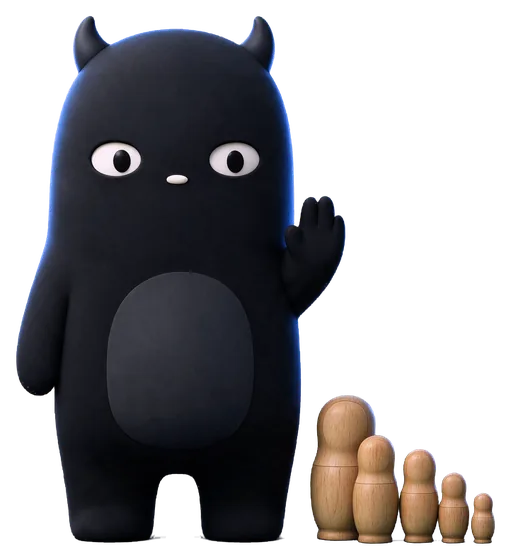
禁止套娃 means “no nesting dolls”. You say it when something repeats inside itself: a video of a video, a quote of a quote, a reply that copies the reply above it.
- Took off
- 2020
- Started in
- Bilibili comments
- Today
- Now everyday Chinese
What it means
套娃 is a set of Russian nesting dolls, one inside the next. Online, 套娃 means any loop of the same thing inside itself. 禁止 is the “no” of public signs, as in 禁止吸烟, “no smoking”.
The joke keeps itself going. Someone writes 禁止套娃, the next person writes 禁止禁止套娃, and the loop goes on.
How people use it
It is still a common reply. Use it for a screenshot of a screenshot, a meme about a meme, or a friend who answers your question with the same question.
周末你想干嘛?
What do you want to do this weekend?
你想干嘛我就干嘛
Whatever you want to do.那你想干嘛?
So what do you want to do?你想干嘛?
What do you want to do?禁止套娃!
Stop the loop!
More examples
截图里还有截图,禁止套娃!
A screenshot inside a screenshot? No nesting dolls!
你用我的问题回答我的问题,禁止套娃。
You answered my question with my question. No nesting dolls.
Where it came from
The phrase spread on Bilibili in late 2019. On January 1, 2020, a Bilibili uploader traced the clip behind it to a 2018 parody video by a YouTube creator, built on a 2011 dance routine.
A Sina column in January 2020 said the phrase kept appearing on anime video sites such as Bilibili and AcFun. In December 2020, Bilibili put 禁止套娃 among its five on-screen comments of the year, Jiemian reported.
The original. A short dance clip from a 2018 parody video by a YouTube creator. A Bilibili compilation from January 2020 collects the source videos and their music. Bilibili compilation (in Chinese)
Related memes


Sources
- Bilibili: the source videos, January 2020 (in Chinese) (bilibili.com)
- Sina, January 2020 (in Chinese) (k.sina.cn)
- Jiemian: Bilibili’s comments of 2020 (in Chinese) (jiemian.com)
Checked November 2026. The picture at the top is our own drawing of 灯灯. It is not the original meme image.
Ten Chinese memes
One Chinese internet meme every three days for a month: where it came from, what it means and how to use it.