Family members in Chinese
 Leon·November 27, 2026·7 min
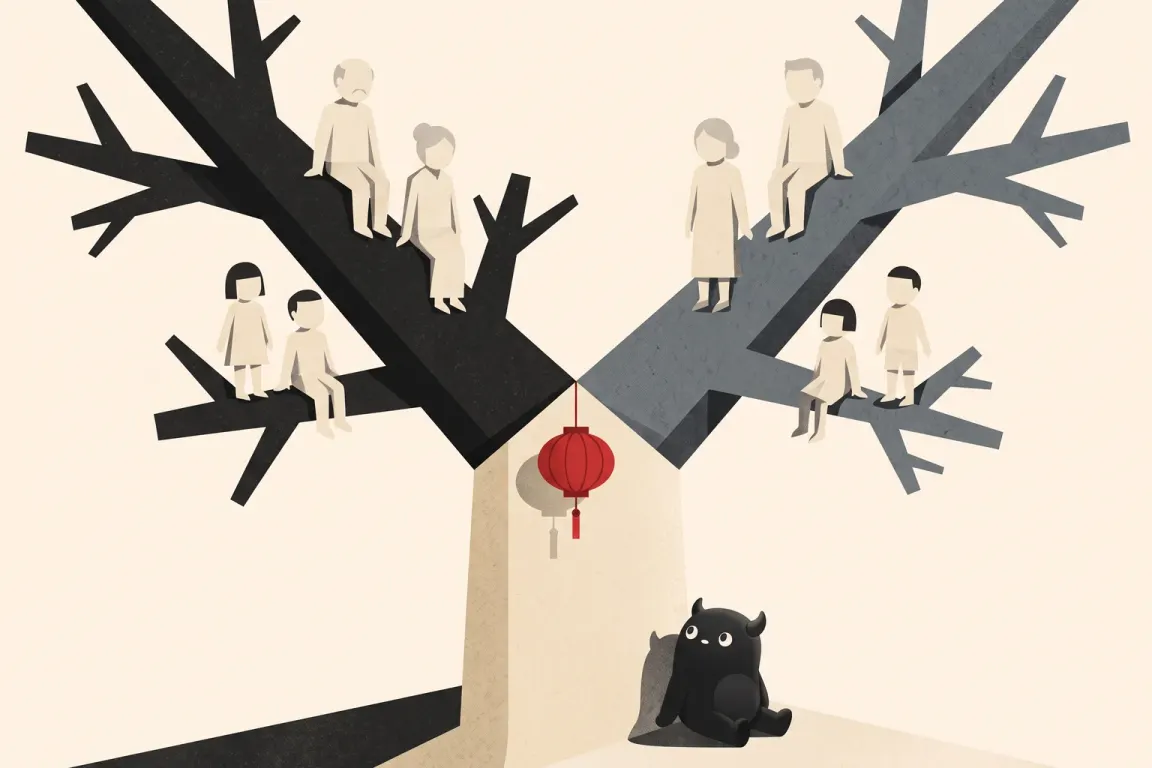
Chinese has a separate word for almost every relative. Your father's father is , your mother's father is , and an older brother has a different word from a younger one.
English uses "grandfather", "uncle" and "cousin" for both sides of the family. Chinese has different words for each side, and for older and younger relatives. Sometimes the word also depends on whether you are related through a man or a woman.
, , , , , , and are all in HSK 3.0 level 1.
Most of the others are in higher levels. and , the mother's parents, are in the HSK 7–9 band, and so is , "relatives".
We publish Dengdeng, a reading app with real stories from China, and our Beginner stories have a Home & family topic. You can tap every Chinese word on this page for its pinyin, meaning and sound.
Parents and siblings
is dad and is mom. and are the formal words, for writing and speeches.
There are separate words for older and younger brothers and sisters.
| Word | Meaning |
|---|---|
| older brother | |
| older sister | |
| younger brother | |
| younger sister |
So "I have a brother" is either or . In Chinese, you have to say whether he is older or younger than you.
All four together are , "brothers and sisters". is a common question when people first meet.
For the family as a whole, means your family and means your relatives.
Grandparents
Your father's parents are and . Your mother's parents are and .
The in means "outside". In the traditional family, a woman joined her husband's family when she married, so her parents counted as relatives from outside the family. Few families think of it that way now, but the words are still in use.
In northern China, many people call their mother's parents and instead. In the south, and are the usual words.
The choice of word caused a public dispute in 2018. A Shanghai primary-school textbook changed to in a children's story, on the grounds that was the standard Mandarin word. People across the south objected, and the city's education commission had the publisher change it back to 外婆.
Aunts and uncles
English uses only "aunt" and "uncle" here, but Chinese has a separate word for each of these relatives.
| Word | Who |
|---|---|
| father's older brother | |
| father's younger brother | |
| father's sister | |
| mother's brother | |
| mother's sister |
Your father's brothers have different words by age, as siblings do. Your mother's brothers all have one word: .
There are also words for the people they marry. is the wife of , is the wife of , and is the wife of . The husbands of your aunts are and .
Large families add a number for birth order. is your father's brother who was born second, and is your mother's third sister.
Cousins
The words for cousins are the sibling words with a prefix. is an older male cousin, is a younger female cousin, and so on. As with siblings, the word depends on age.
The prefix depends on how the cousin is related to you.
- is for the children of your father's brothers.
- is for every other cousin: the children of your father's sisters, and of your mother's brothers and sisters.
The reason is the family name. Children traditionally take their father's surname, so the children of and have the same surname as you. They are cousins. A cousin related through a woman usually has another surname, so they are .
So 's children are cousins, even though she is your father's sister.
Husbands, wives and in-laws
The everyday words for husband and wife are and . and are the formal words, used on forms. Older people also say , "spouse".
A woman's parents-in-law are and . A man's parents-in-law are and , or in speech and .
You use those words when you talk about them. When talking to them, most people say and after the wedding.
Family words for strangers
Chinese also uses family words for people who are not family.
A child calls an adult man and an adult woman . Adults use the same words for strangers of their parents' age. An elderly stranger is or , and someone a little older than you can be or .
People also often call a nanny or a cleaner .
New Year visits
At Spring Festival, many people visit relatives they see once a year. This is called , "visiting relatives".
There is a phrase for these relatives: , "seven aunts on dad's side, eight on mom's". It means a big group of relatives. People often use it for relatives who ask personal questions, such as how much you earn or when you will marry.
With that many people, a distant relative's title is hard to work out. Relationship calculators exist for this: you tap , , or in a chain and get the title. Xiaomi built one into its phones' calculator app, and Chinese news sites covered it before the 2017 New Year.
Common questions
What is the difference between 外婆 and 姥姥?
Both mean your mother's mother. is the usual word in the south, and in the north.
How do you say "cousin" in Chinese?
Put or in front of a sibling word. is for your father's brothers' children, and for every other cousin.
What is the difference between 叔叔 and 伯伯?
is your father's older brother, and his younger brother. Children also call any adult man .
Dengdeng's Beginner stories include a Home & family topic: short stories about families, for learners at about HSK 3.0 levels 1–2. In the app, you can open one Beginner story free every day. You can try a story preview on the web first, or look up any word from this page in Dengdeng Dictionary.
A slang word a week
One Chinese internet slang word every week for ten weeks: what it means, where you'll see it, and how to use it.
Also on the Blog
Learn Chinese from scratch with our new HSK 1 and HSK 2 course
Dengdeng now has a complete Foundation course: 35 units and 139 short lessons that take you from your first word through HSK 1 and HSK 2. One new lesson a day is free.
 Nov 27, 2026 · 3 minRead
How to order food in Chinese
To order food in Chinese, say 我要 or 来一份 and the dish. Ask for the bill with 买单. You also need words for scan-to-order menus, spice levels, 不要香菜, 打包, delivery and paying. Most restaurants in China do not expect a tip.
Nov 24, 2026 · 7 minRead