Chinese festivals
Double Ninth Festival in Chinese
 Leon·Updated October 14, 2026·6 min
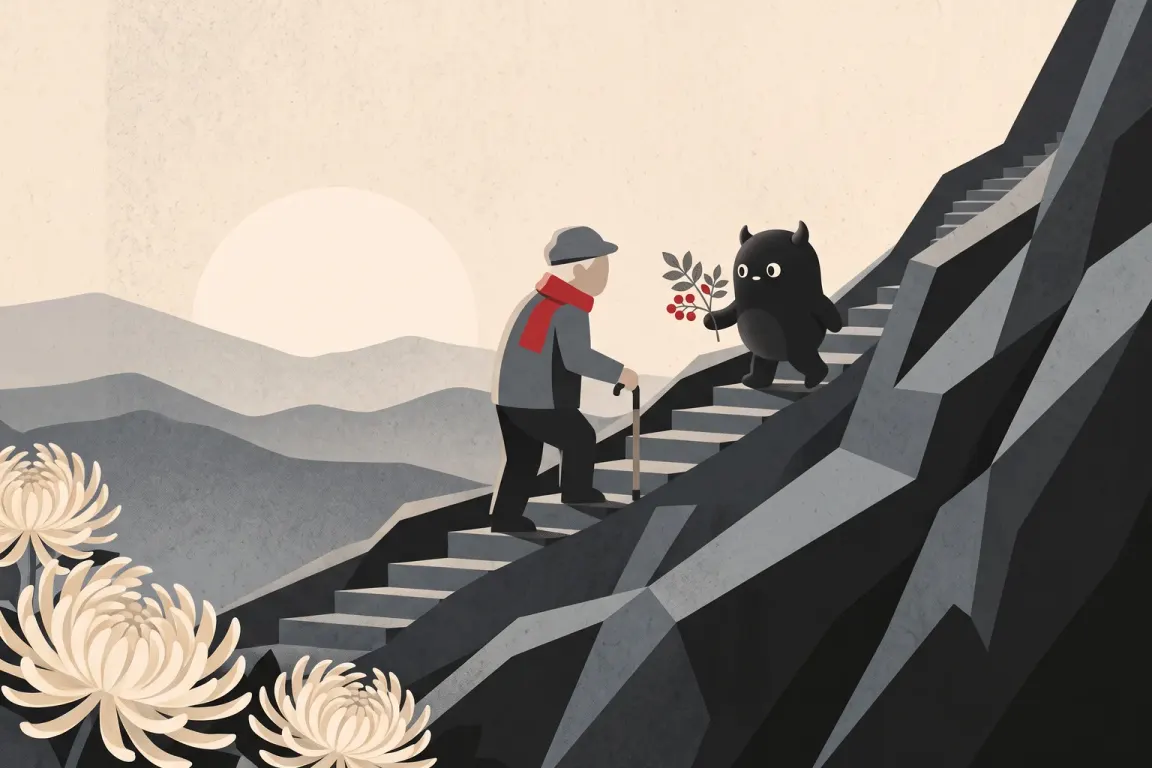
The Double Ninth Festival is an autumn day for climbing hills, looking at chrysanthemums, and visiting older relatives. In 2026 it falls on Sunday 18 October.
In Chinese it is , the Chongyang Festival. It is also China's Seniors' Day, so for many families it is the day to call or visit the grandparents.
We publish stories from China in Dengdeng, our reading app, at three levels. Knowing words like and helps when the festival comes up in a headline or a conversation.
The date
The festival is on , the ninth day of the ninth month in the lunar calendar. People also call it .
On the Western calendar it usually falls in October. In 2025 it was 29 October. In 2026 it is Sunday 18 October.
It is not a public holiday in mainland China. Hong Kong has a public holiday, and because the festival is on a Sunday this year, Monday 19 October is the day off.
Many Hong Kong families use the day to visit their ancestors' graves. They call it , "paying respects on the hill", because most cemeteries there are on hillsides.
Why nine
means "double yang". is read chóng here, "again, double", and not zhòng, "heavy". It is one of the characters with more than one pronunciation.
In the , the Book of Changes, odd numbers are yang, and nine is the largest single-digit odd number. The ninth day of the ninth month has two nines. That gives the day its name, and a second one: , "double nine".
Nine is also a pun. is jiǔ, and so is , "a long time". Say and it sounds like , "for a long, long time". So people link the date with a long life.
The pun is old. In the third century, Cao Pi, the first emperor of the Wei dynasty, wrote in a letter that people liked the name of the day because it suited , "long-lasting".
Climbing high
The main custom is , "climbing high". is to climb, and is high.
A Han dynasty legend explains it. A teacher, Fei Changfang, told his student Huan Jing that disaster would come to his home on the ninth day of the ninth month. The family should climb a mountain, wear bags of on their arms, and drink chrysanthemum wine.
They did. When they came home in the evening, their animals were all dead, and the family was safe. The writer Wu Jun recorded the story about 1,500 years ago.
Today mostly means a hike. Many people go , up a hill or a mountain, on the day, often with older relatives. Some neighborhood groups organize climbs for older residents.
Chrysanthemums
The ninth lunar month is chrysanthemum season, so is the festival flower. Looking at them is , built like , looking at the moon, at the Mid-Autumn Festival.
Old texts list , chrysanthemum wine, as a drink for a long life. The everyday drink from the same flower is , chrysanthemum tea.
Cities hold chrysanthemum shows in October and November.
and Wang Wei's poem
is a plant with a strong smell and small red fruit. The China Intangible Cultural Heritage Network identifies it as , a plant in the citrus family. Some English accounts instead call it dogwood.
People wore a sprig in their hair or carried it in a small bag to keep bad luck away. Few people do this now.
The word appears in Wang Wei's , "Remembering my brothers east of the mountains on the ninth day of the ninth month". He wrote it at 17, far from home.
here means "east of the mountains", where his family lived. It is not today's Shandong province.
People often quote the second line at festivals: , "at every festival, I miss my family twice as much".
The last two lines return to the festival customs:
Far away, I picture my brothers climbing high.
Each wears a sprig; one person is missing.
The missing person is Wang Wei himself. is the climb, and is the sprig they wear.
Double Ninth cake
The festival food is , Double Ninth cake. It is a rice cake, often in layers. Old recipes top it with chestnuts, ginkgo nuts, or pine nuts, and a small paper flag.
The name is a pun again. is gāo, "cake", and is gāo, "high". Eating the cake makes the same wish as the climb: , "rise higher with every step".
1.Illustration of , chrysanthemums with their curled petals and lobed leaves
2.Illustration of , layered rice cakes with a small paper flag
3.Illustrated calendar for : Sunday 18 October 2026,
Seniors' Day
The wish for a long life connects the festival with older people. China named it , Seniors' Day, in 1989. A law that took effect in 2013 made the date official as .
The same law asks family members living apart to visit or check in often. Chinese media described it as written into law: "come home often".
How families mark it
The idea behind the day is , respect for older people. The word you hear with it is , being good to your parents and grandparents.
In practice, that often means a phone or video call, or a visit. Some people take their parents or grandparents out for a meal or a walk.
The family words distinguish the two sides:
- and : Grandpa and grandma on the father's side.
- and : Grandpa and grandma on the mother's side. In the north, many people say and .
- : Mom and dad.
Neighborhoods also hold events for older residents through the local , the residents' community: a shared meal, performances, and care services. , volunteers, visit the , nursing homes. In some kindergartens, children make with their teachers.
What people say
A festival greeting is , "happy Double Ninth". To an older person, you can add , "I wish you good health and a long life". is the polite "you".
A simple plan for the day:
,。
Let's go for a hike together on Double Ninth.
Two other phrases connect the day with family:
- : Come home often.
- : Wang Wei's line, for anyone away from home on the day.
Common questions
When is the Double Ninth Festival in 2026?
Sunday 18 October 2026. It is the ninth day of the ninth lunar month, so the Western date changes every year.
What does 重阳 mean?
"Double yang". Nine is a yang number, and the ninth day of the ninth month has two of them.
Is the Double Ninth Festival a public holiday in China?
No, not in mainland China. Hong Kong has a public holiday, which in 2026 is Monday 19 October.
What do people eat on the Double Ninth Festival?
, a layered rice cake. Its name works as a wish because , "cake", sounds like , "high".
Why is the Double Ninth Festival also Seniors' Day?
Because sounds like , "for a long time", the day has long been linked to a long life. A law revised in 2012 made it China's official Seniors' Day, , from 2013.
Sources
- China Intangible Cultural Heritage Network: on the festival's customs, including Cao Pi's letter, , , and the 1989 Seniors' Day.
- Xinhua: from 老人节 to 老年节, 2024.
- Beijing Municipal Government: the text of the 老年人权益保障法, Articles 12 and 18.
- China News Service: the Double Ninth cake and chrysanthemum wine, 2023.
- Gushiwen: Wang Wei's poem with notes.
- PublicHolidays.hk: Hong Kong holiday dates.
- Wikipedia: Double Ninth Festival, for the Fei Changfang legend.
If you want to keep reading about China after the festival, open today's stories in Dengdeng. Each story comes in Easy, Medium, and Hard. You can tap any word for its pinyin and meaning, and one story from each daily edition is free in the app.
Coming up
The full festival calendar →
A slang word a week
One Chinese internet slang word every week for ten weeks: what it means, where you'll see it, and how to use it.