Chinese festivals
Mid-Autumn Festival words in Chinese
 Leon·Updated September 24, 2026·6 min
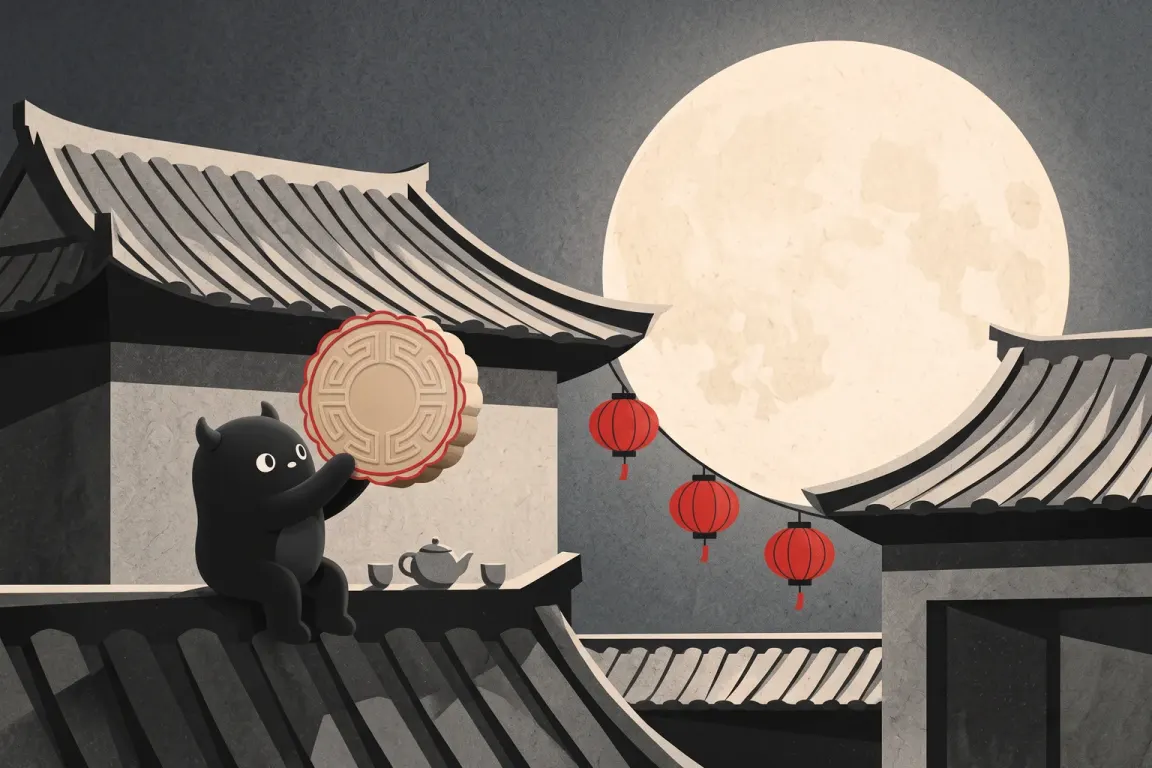
The Mid-Autumn Festival is a night for the full moon, family, and mooncakes. In 2026 it falls on Friday 25 September.
In Chinese it is , "mid-autumn festival". It is one of the few dates in the year that nearly everyone in China marks in some way, even if only with a box of mooncakes from work.
We make Dengdeng, a reading app with real stories from China. Festivals are a good way into that: the vocabulary is concrete, and it comes back every year.
The date
The festival follows the lunar calendar. It falls on , the 15th day of the eighth month, when the moon is full.
On the Western calendar it moves between mid-September and early October. It is a public holiday in mainland China.
Some years it lands close to National Day on 1 October, and the two holidays join. In 2023 and 2025 that gave people eight days off in a row. In 2026 they are a week apart.
The moon
The central activity is : looking at the moon, usually outside, usually with family.
A full moon is round, and the word for a family being together uses the same idea. means "reunion", with as in "round". That is why the festival is about going home.
People say it in a short line: . When the moon is round, people come together.
If you cannot go home, the moon is still the one thing you share. Two famous poems are about that feeling.
Li Bai's is often the first classical poem a child learns in China. Its last line is ,: I raise my head to look at the bright moon, then lower it and think of home.
Su Shi wrote at Mid-Autumn in 1076, missing his brother. It ends with ,: I only wish we both live long, and share this moon from a thousand miles apart. You will see the line on cards and gift boxes every year.
Chang'e and the jade rabbit
The festival's story is , "Chang'e flies to the moon". In the usual version, Chang'e swallows an elixir of immortality and floats up to the moon, where she lives alone.
She has a companion there: , the jade rabbit, who pounds medicine with a pestle. Look at the full moon and some people see the rabbit's shape in the dark patches.
China's lunar program uses both names. The spacecraft are called , and the rovers that drove on the moon were and .
Mooncakes
The food is , "moon cake": a round pastry with a dense filling, often stamped with a pattern on top.
Most of the difference is in the filling.
| Word | Filling |
|---|---|
| Lotus seed paste. Smooth and sweet, the classic Cantonese choice. | |
| Sweet red bean paste. | |
| Salted egg yolk, set in the middle to look like the moon. | |
| "Five kernels": nuts and seeds, often with candied fruit. | |
| Snow skin. A soft, chilled rice-flour crust instead of baked pastry. |
is the one people argue about. For years it has been the joke answer to "worst mooncake", and the joke has fans who defend it.
Styles differ by region. , Cantonese style, has a thin, shiny crust. , from Suzhou, has a flaky crust, and some are savory, filled with pork.
Mooncakes are also a gift. Companies hand out , mooncake gift boxes, to staff and clients, and the boxes can be far more elaborate than the cakes.
Lanterns
In southern China and in Hong Kong, children carry , lanterns, on the festival night. Parks hang rows of them.
Our name comes from the same word. is a playful doubling of , "lamp", as in .
What people say
The standard greeting is , "happy Mid-Autumn". is the full form.
On the day, you will read these words everywhere.
- : Go home. The trip that makes the festival.
- : The reunion dinner, with the family at one table.
- : Looking at the moon after dinner.
- : The cakes, bought, gifted, and passed on.
- : The holiday, and how many days it lasts this year.
If you want to read more stories from China this week, see today's stories in Dengdeng. Each one comes at three levels, and every word you tap shows its pinyin and meaning.
Coming up
The full festival calendar →
A slang word a week
One Chinese internet slang word every week for ten weeks: what it means, where you'll see it, and how to use it.