Chinese festivals
National Day Golden Week in Chinese
 Leon·Updated September 28, 2026·6 min
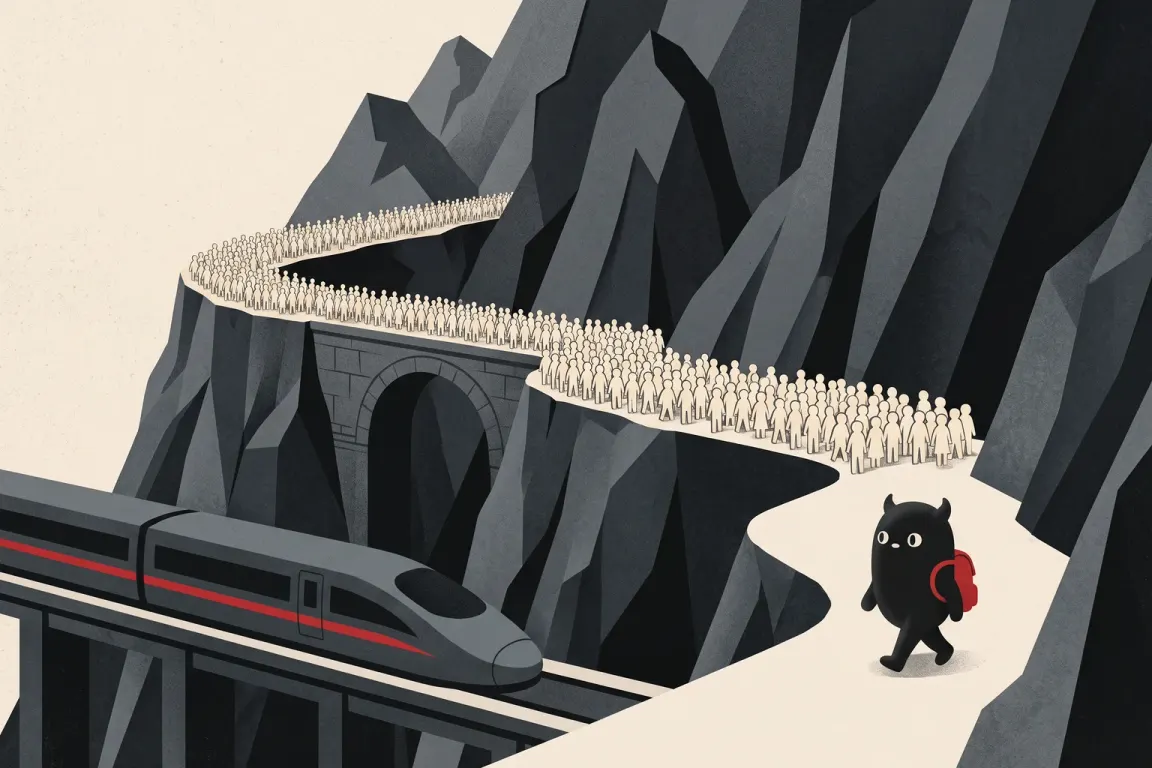
From 1 to 7 October, most of mainland China is on holiday at the same time. It is called , Golden Week, and a large part of the country travels.
The holiday is , National Day, on 1 October. The week around it is when people go home, go sightseeing, or decide the crowds are not worth it and stay in.
We make Dengdeng, a reading app with real stories from China. Around this week, a lot of it is about trains, queues, and whether the time off was worth the extra working days.
Where the week comes from
National Day marks the founding of the People's Republic on 1 October 1949.
The seven-day break is newer. In 1999 the government rearranged public holidays and weekends to create long breaks, partly to get people traveling and spending. Those long breaks got the name .
There were once three of them. The May Day week was cut back in 2008. Two remain: Spring Festival and National Day.
and
Only part of the week is extra holiday. The rest is borrowed from nearby weekends.
This is : the working days and rest days are swapped around, so the break is continuous. The price is , a make-up working day, usually a Saturday or Sunday next to the holiday.
That means a six- or seven-day working week before or after the break. Every year, when the schedule is published, becomes one of the most discussed words online. Plenty of people say they would rather have fewer days off and no weekend shifts.
Getting there
Train tickets go on sale in advance on 12306, the national railway booking app, and the popular routes sell out fast. People call this : "grabbing tickets".
Many take the , high-speed rail. Many drive.
During the four big holidays, small passenger cars pay no tolls on the expressways. The policy started in 2012. It also explains the traffic: , traffic jam, is a Golden Week headline every year.
The most famous Golden Week joke is written with three characters.
is a person. is two people. is three people, and means "a crowd".
Put them in a row, , and you have a caption for any photo of a packed scenic spot: a bridge with no visible bridge, a mountain path shoulder to shoulder, a beach you cannot see the sand of.
A few more words come with those photos.
- : "people mountain, people sea". A huge crowd.
- : A scenic area, usually ticketed and gated.
- : The entry ticket.
- : Queuing, often for longer than the visit.
Doing it differently
Two expressions describe people who avoid the rush.
means traveling off-peak. Leave before the holiday, come back after it, or go somewhere at a different time entirely.
, "reverse tourism", is the trend of going where everyone else is not: a small city instead of a famous one, or the place your friends are leaving.
And some people stay put. means staying home: sleeping, gaming, and ordering in while the photos of crowds come in.
What people say
The greeting is , "happy National Day". On the last evening, you will see a different mood in the comments.
- : "Holiday balance low." The low-credit warning, borrowed for the last days of the break.
- : Settle your mind back down. Getting ready for work again.
- : Going back to work, often on a weekend.
If you want to read more stories from China after the holiday, see today's stories in Dengdeng. Each story comes at three levels, and you can tap any word to see its pinyin and meaning.
Coming up
The full festival calendar →
A slang word a week
One Chinese internet slang word every week for ten weeks: what it means, where you'll see it, and how to use it.