Chinese festivals
Winter Solstice in Chinese
 Leon·Updated November 18, 2026·6 min
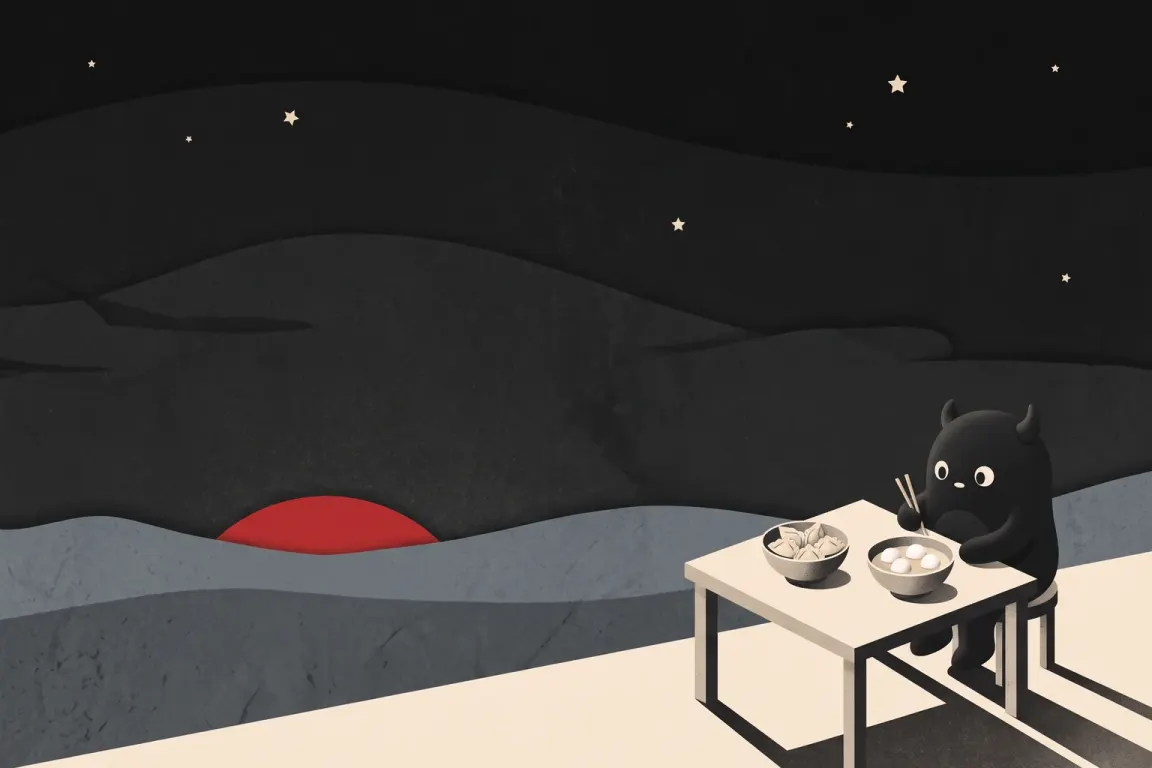
The Winter Solstice is the shortest day of the year, and in China it is also a day for a family dinner. In 2026 it falls on Tuesday 22 December.
In Chinese it is , Dōngzhì. is winter. means "to arrive", and also "the furthest point". The sun is at its lowest, and from the next day the days get longer.
In the north, people eat , dumplings. In the south, they eat , sweet rice balls. We publish stories from China in Dengdeng, our reading app, at three reading levels, and you can tap any word in them for its pinyin and meaning.
A solar term
is one of the , the 24 solar terms. They divide the year by the sun's position, about 15 days apart, and they were made for farming. UNESCO added them to its intangible heritage list in 2016.
Most solar terms are only dates on the calendar, but is one of the few that people still celebrate.
Its date is set by the sun, not the moon, so it is always on 21, 22 or 23 December. In 2026 the solstice is at 4:50 a.m. Beijing time on 22 December.
It is not a public holiday in mainland China. In Hong Kong, it is a statutory holiday that employers can give instead of Christmas Day.
The solstice and New Year
An old saying compares the day with Spring Festival: , "the solstice is as big as New Year". It is recorded in , a Qing dynasty book about the customs of Suzhou.
A common explanation for the saying is that the Zhou dynasty calendar started the year in the month of the solstice.
In Guangdong and Hong Kong, the Cantonese version is , "winter is bigger than New Year". The family dinner there is called , "doing winter".
The poet Du Fu wrote about the day in the eighth century. His poem opens:
,。
The seasons and human affairs press on each other day by day. At the solstice the yang starts to grow, and spring comes again.
means that after the longest night, yang starts to grow again. In Chinese thought, yang is the light and warm principle.
Dumplings in the north
There is a northern saying about eating at the solstice:
,。
If you don't pick up a bowl of dumplings at the solstice, your ears will freeze off and nobody will care.
The saying is about ears because a looks a little like an ear.
There is a legend about this from Nanyang, in Henan. Zhang Zhongjing, a famous doctor of the Han dynasty, came home in winter and saw that people's ears were frostbitten. He boiled mutton with warming herbs, wrapped the filling in dough shaped like ears, and gave them out in a soup. He called them , "delicate ears". The China Intangible Cultural Heritage Network presents the story as one account of the custom, not as history.
Tangyuan in the south
In much of the south, and above all in the Jiangnan region around Shanghai and Suzhou, the food is . They are balls of glutinous rice, often filled with black sesame, and served in their cooking water.
The name sounds like , "together again", so people eat them at family meals. At the solstice they are also called .
A saying goes with them: , "eat your tangyuan and you are a year older". In this saying, the solstice is the start of a new year.
Some Jiangnan families also eat , sticky rice with red beans, on the night before.
Other places have their own dish. Parts of Shandong eat , mutton soup. In Suzhou, people buy , a sweet rice wine made for the season, and drink it on , the night before the solstice.
Counting the nines
The solstice starts the coldest part of the year. People count it in nines: , "counting the nines".
The 81 days after the solstice are split into nine periods of nine days. The first is , the second , and so on to . The coldest stretch is usually , the third period. is a common way to say "the coldest days of winter".
A counting rhyme, the , has a line for each period. A northern version starts:
,。
In the first and second nines, you do not take your hands out. In the third and fourth nines, you walk on the ice.
The last line is about spring:
,。
Nine nines and one more nine, and the plow oxen are out in all the fields.
The nine-nines chart
The , "chart to dispel the cold of the nine nines", is a calendar you fill in.
One version is a branch of plum blossom. It has nine flowers with nine petals each, 81 petals in all. You color one petal a day, starting at the solstice. When the last flower is colored, the 81 days are over.
The other version is a line of nine characters in calligraphy. The best-known one is:
The willows in front of the pavilion wait for the spring wind.
Written in traditional characters, each of the nine has nine strokes. The characters are drawn in outline, and you fill in one stroke a day. This only works in traditional characters: the simplified has four strokes, and has nine.
Charts like this often have the title . is an old literary name for the writing brush, so the title means "the brush is full of spring".
What people say
- : Happy solstice. The plain greeting.
- : "Peace and good health at the solstice." A more formal greeting.
- : Have you had your dumplings?
- ,: The north eats dumplings, the south eats tangyuan. The usual way to describe the day's food.
A message to someone far from home might be:
,。
It's the solstice. Remember to eat some dumplings.
Common questions
When is the Winter Solstice in 2026?
Tuesday 22 December 2026, in China. The solstice itself is at 4:50 a.m. Beijing time. In Europe and the Americas, the same moment is still on 21 December.
What do Chinese people eat at the Winter Solstice?
Most families in the north eat , dumplings. In much of the south, and in the Jiangnan region above all, they eat , sweet rice balls.
Is the Winter Solstice a public holiday in China?
Not in mainland China. In Hong Kong, it is one of the statutory holidays, which employers can give instead of Christmas Day.
What does 数九 mean?
"Counting the nines". The 81 days after the solstice are counted in nine periods of nine days, and , the third, is usually the coldest.
What does 冬至大如年 mean?
"The solstice is as big as New Year". It is an old saying, common in Suzhou, and it means the day is as important as Spring Festival.
Sources
- China Intangible Cultural Heritage Network: the solstice in the 24 solar terms, for the , the dumpling saying and its Zhang Zhongjing account, the Jiangnan and customs, and .
- Xinhua: counting the nines, 2024, for the plum-blossom and calligraphy charts, and .
- Hong Kong Labour Department: statutory holidays for 2026.
- Star Walk: the time of the December 2026 solstice.
- The Paper: the Zhang Zhongjing legend, from the Jiading district health office, 2020.
- China Intangible Cultural Heritage Network: Du Fu's 小至.
Dengdeng has a new edition of stories from China every morning. Each story comes in Easy, Medium and Hard, and you can tap any word, included, for its pinyin and meaning. One story from each daily edition is free.
Coming up
The full festival calendar →
A slang word a week
One Chinese internet slang word every week for ten weeks: what it means, where you'll see it, and how to use it.